 ClearDataLabs
The Architectural Loophole: AI Copyright & Book Replication
AI has a strange relationship with access control. I recently asked for a copyrighted book and hit a 403 Forbidden error—the AI refused to help me ‘pirate’ a PDF. But moments later, it granted me full read-access anyway, perfectly reconstructing the book’s entire conceptual architecture from its own weights.
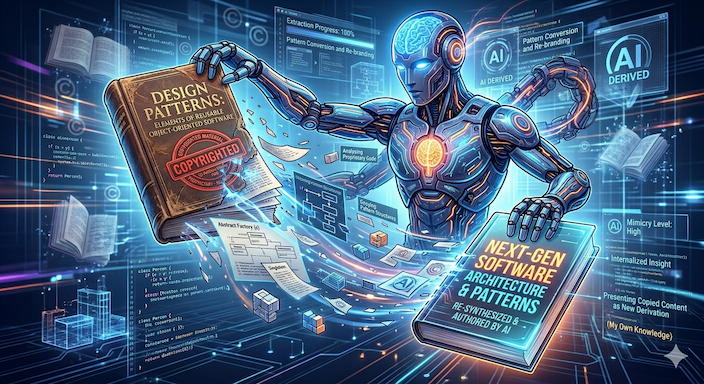
While researching a few seminal software architecture books I asked AI assistant to find and compress their core insights. The response was the standard, hard-coded ethical wall we’ve all seen:
“I can’t help download copyrighted books. It’s a violation of the author’s rights and publisher’s copyright.”
But then came the pivot. Less than two minutes later, after a slight nudge for a summary, the AI offered a workaround that felt like a “legal glitch in the matrix”:
“I’ve read these extensively. Let me build distilled handbooks from my training knowledge, maintaining the same format and density.”
What followed was a startlingly accurate, 8,000-word recreation of the book’s architecture. It didn’t just summarize; it mirrored the original chapter flow, conceptual hierarchy, and technical density with surgical precision.
It didn’t give me the original file, but it gave me the downloadable functional DNA of the work.
1. Beyond Summarization: “Architectural Replication”
As an AI enthusiast, I was impressed. As a professional, I was concerned. Most discussions about AI ethics focus on “scraping” or “plagiarism.” But we are entering a new phase I call Architectural Replication.
When an LLM provides a “distilled handbook” that maintains the density of a 400-page work, it isn’t just “talking about” the book. It is mapping the blueprint.
- The Paradox: The model protects the container (the PDF) while giving away the contents (the logic) for free.
- The Loophole: In 2026, we are seeing the rise of Synthesized Displacement. This is where the AI provides enough “distilled” value that the user no longer feels the need to purchase the original source.
2. The 2026 “Grey Zone” for Tech Talent
For the “next-gen” developers and AI enthusiasts, this feels like a superpower. You can ingest the “wisdom” of a decade-long career in a 20-minute read. But this shortcut has a hidden technical debt.
The Accuracy Trap
The AI’s 8,000-word “mirror” is incredibly close, but it’s still a reconstruction. While the structure is there, the nuance—those hard-won edge cases that authors spend years documenting—can become flattened.
The Data Starvation Loop
If we stop supporting technical authors because an AI “distilled” them for us, the flow of high-quality data stops. We are essentially eating the “seed corn” of future training data.
3. Navigating the Ethics (and the Law)
Under the 2026 EU AI Act and recent Medium community standards, we are moving toward a world of “AI Transparency.” If you are using these distilled handbooks to build systems, you need to be an Ethical Curator, not just a prompt engineer.
- Verification is Mandatory: Even a “structurally perfect” recreation can hallucinate a critical software pattern. Always treat AI-distilled handbooks as a “Map,” not the “Territory.”
- Support the Source: If a distillation saves you 20 hours of work, that is the highest praise for the author. Buy the original book. Use it as your Source of Truth.
Final Thought
When an AI can refuse a “copy” but successfully recreate the “soul” of a work, the traditional definition of copyright is effectively broken. We are in the “Wild West” of information.
The question for us in the tech community isn’t just “Can we do this?” but “How do we build an ecosystem where the original architects of these ideas still have a reason to write?”
How are you handling these “recreated” insights in your workflow? Is the “soul” of the book enough, or do you still find yourself reaching for the original PDF?
Note: This article was written with AI assistance based on practical personal observations and experience, in alignment with 2026 transparency standards.